
So Where Do We Go from Here? A Practical 2026 Agenda for AI-Enabled Marketing

There’s a point in every transformation where the excitement of early experiments gives way to the more uncomfortable work of actually changing how things get done. Marketing has just reached that point with AI.
Almost every organisation has experimented with AI. Far fewer have begun to scale it.
McKinsey’s 2025 State of AI shows nearly 90% of companies now use AI somewhere, but only around one-third are scaling it across the business, and fewer still are capturing measurable EBIT impact.
Firms that have moved into scaling are already reporting tangible benefits: Bain found early movers achieving 10–25% stronger return on ad spend, and Mondelez expects 30–50% reductions in content production costs through a scaled GenAI workflow.
These early results don’t prove a fully formed performance gap yet, but they clearly signal that one is starting to open up. And if scaling continues to concentrate in a small group of companies while others remain in pilot mode, that gap is likely to widen over the next 12–24 months.
AI hasn’t rewritten what works in marketing. It’s rewriting the conditions in which marketing is done. That shift is the heart of AI-enabled marketing: not new tactics, but new conditions for how strategy, creativity and decision-making happen.
Across this eleven-part series on how AI is reshaping marketing in 2025, the themes have been consistent: fundamentals, people, value, operating models, and culture. This final piece brings those threads together into a single question: What should leaders actually do in 2026 that will move the dial?
This is not a roadmap for more tools or more pilots. It’s a short agenda for the teams who want AI to make marketing better, not just faster or cheaper.

1. Re-anchor on the fundamentals (and let AI amplify them)
The most important truth in modern marketing is also the least fashionable: the fundamentals have barely shifted.
Binet and Field’s work on long–short balance still holds. Emotional, broad-reach brand building still compounds. Distinctive assets still outperform clever targeting. Ehrenberg-Bass research still reminds us that mental and physical availability drive growth, not algorithmic precision.
AI doesn’t change any of this. But it does change our capacity to execute it.
AI can help teams scale distinctive assets, analyse brand consistency, synthesise research, model reach effectively, and generate stronger creative territories, but it cannot set strategy or protect a brand’s truth.
The danger is the opposite: an avalanche of AI-generated output that blurs categories and erodes distinctiveness. As Helen Edwards writes, creative judgement and taste become even more important in a world where competent sameness is easy to produce.
If 2026 has a single marketing rule, it’s this:
AI accelerates whatever you already are. Make sure you’re worth accelerating.
2. Embed AI into the decisions that actually matter
Most organisations still treat AI as a collection of use cases. Leaders ask:
“Where else could we experiment?”
“Which tools should we add?”
“How do we keep up with the pace of change?”
These are the wrong questions.
Marketing teams don’t need more experiments. They need decision redesign.
The shift now is from tools to workflow. From “try this model” to “change how we make choices”.
There are roughly five marketing decision flows where AI can deliver real impact in 2026:
Annual planning and budget allocation
AI strengthens scenario modelling, value estimation and sensitivity analysis, especially when marketing and finance use shared inputs.
Creative briefing and ideation
AI can expand the territory and generate rough cuts, while humans protect taste, brand truth, emotional resonance and cultural intelligence.
Media planning and channel mix
As Mark Ritson points out, increasing parts of media planning will become automated. Diagnosis and strategy will not.
In-campaign optimisation
AI thrives in feedback loops. Humans thrive in interpretation. Put them together.
Audience insight and segmentation
Synthetic data, journey modelling and automated insight synthesis are now practical capabilities, not science fiction.
Don’t ask “where to pilot next”. Ask “Which decisions do we rebuild with AI inside?”
3. Reset the AI-enabled marketing operating model that surrounds those decisions
This is the uncomfortable part, and it’s where the value sits.
AI is not a marketing tool. It is a change in how marketing works.
High-performing organisations are already shifting their operating models in four ways:
a) Cross-functional, not siloed
Marketing joined by product, sales, data and finance in smaller, clearer teams.
b) Clear decision rights
Not every decision is made by “the model”.
Not every decision is made by “the HIPPO”.
I covered this in an earlier post on governance: the right default, the right escalation, the right human override.
c) Scaled platforms, not scattered tools
A coherent AI ecosystem where models, data and workflows play together, not a digital junkyard of individual apps.
d) Rebuilt workflows
Briefing, approvals, creative review, optimisation, learning loops — all redesigned with AI embedded from the start.
The point is simple. You cannot accelerate a system that wasn’t built to move.
AI doesn’t magically transform a slow, fragmented operating model. It exposes it.
4. Invest in the human capabilities AI cannot replace
Every major voice in marketing, including Sharp, Binet & Field, Ritson, Edwards, converges on one idea: AI will change tasks and workflows, but it will not replace the human capabilities that create differentiation.
Capabilities to protect and grow in 2026:
Taste and creative judgement
AI can remix the past. Humans decide what the future should feel like.
Cross-functional collaboration
AI reduces coordination friction. It does not create alignment.
Integrated commercial thinking
The CMO–CFO bridge is more important than ever.
I covered this in an earlier post “Spend Better, Market Better”.
Ethical reasoning and trust-building
AI can generate insight. It cannot assess the societal impact of using it.
Critical evaluation of AI output
Synthetic confidence is dangerous. Leaders need to know when to challenge the machine, not just when to use it.
Training in 2026 cannot be just “here’s how to use the tool”.
It has to be:
“Here’s how to be the human this new system needs.”
5. Build real value discipline and guardrails
The final piece of the 2026 agenda is the one most teams avoid.
The SAS/Coleman Parkes report shows 93% of CMOs see ROI from AI, yet only one in five can track it. Mondelez has already shown what scaled AI looks like: content produced at 30-50% lower cost, with strict human quality and brand guardrails.
Two disciplines now matter:
a) Value tracking
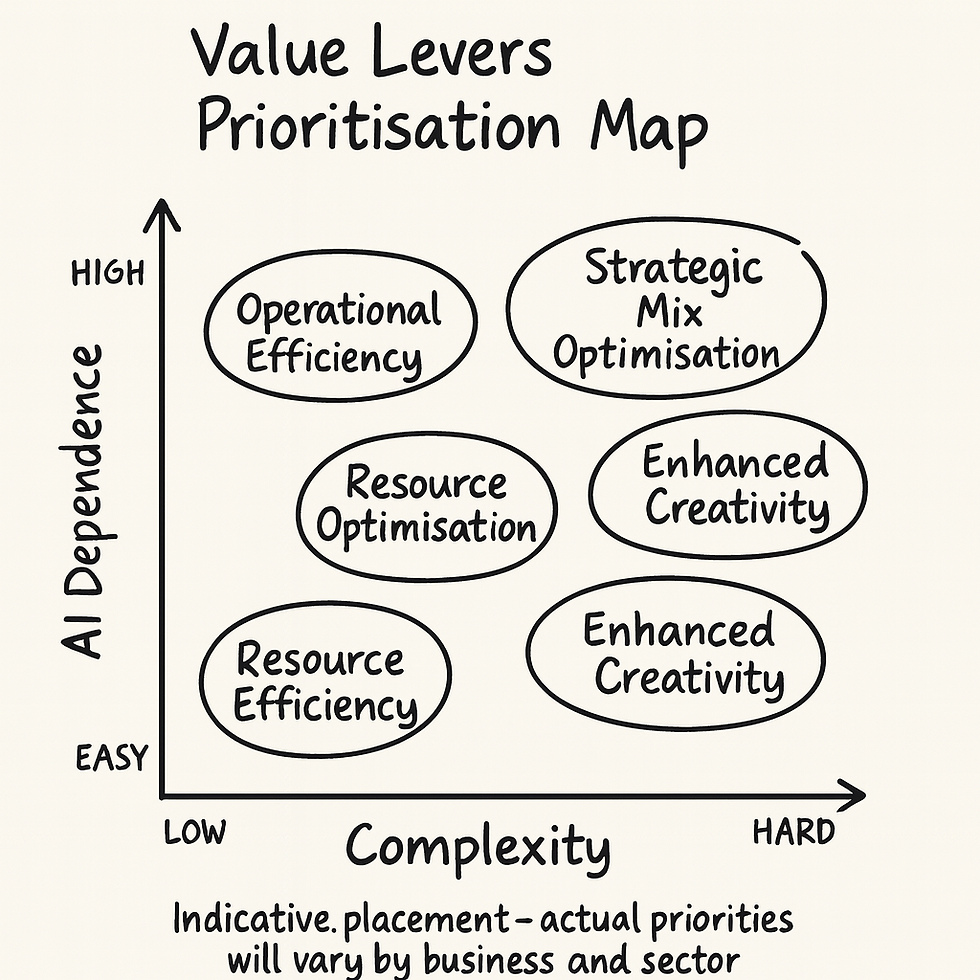
Clear value levers
Shared inputs with finance
Real-time measurement
A joined-up view of brand, demand and commercial outcomes
Your Marketing Value Engine work already sits here.
b) Ethical governance
Clear red lines
Human review protocols
Safety layers around creative, insight, personalisation
Model transparency and audit
Truth discipline, not mistaking synthetic output for fact
AI without value discipline is noise.
AI without guardrails is risk.
The 2026 leader needs to manage both.
So where do we go from here?
The defining leadership choice
After six months of writing about AI and marketing, and conversations with leaders wrestling with these shifts, the conclusion is surprisingly straightforward:
AI is not the destination.
AI is the accelerant.
It accelerates your strategy, your processes, your culture, your governance, whatever shape they’re in.
The organisations that win the next two years will be the ones that:
trust the fundamentals
rebuild their operating model
embed AI in the decisions that actually matter
elevate human judgement
track value with discipline
and govern AI with clarity and integrity
2026 will not reward the teams with the most tools.
It will reward the teams with the most courage to change how they work.
This is the end of this series.
And the beginning of the real transformation.


Comments