
Spend Better, Market Better: Mapping Your Marketing Value Levers

Updated: Sep 5, 2025
“About 10% of campaigns truly move the needle—most never get the attention they deserve.” –
A seasoned CMO reflecting on campaign performance
Performance in marketing tends to follow a familiar pattern: a small number of standouts carry the load, while most campaigns coast without real impact—yet still consume budget and brand energy.
In most marketing portfolios, performance isn’t evenly spread. A few campaigns shine, while many quietly drain budget and brand energy. As I often see in my work, marketing leaders face a critical challenge: deciding where to focus to unlock real value.
But here’s the thing—nobody can give you a universal answer. Marketing experts offer different ways to think about where to direct effort. Byron Sharp underscores the importance of broad reach and distinctiveness. Mark Ritson urges leadership to focus on core strategy—segmentation, positioning—avoiding distractions from shiny tools. Raja Rajamannar highlights the risk of falling behind and encourages agile experimentation in evolving landscapes.
Each perspective offers value. As a leader, your task is to decide what matters most for your brand, your customers, and your market.
I often a framework Spend Better, Market Better as a simple, practical way to map value levers. It’s not a blueprint, but a tool to help focus leadership discussions on where value lies—and also useful to discuss how AI might support unlocking it.
A Framework to 'Spend Better, Market Better'
This framework identifies eight marketing value levers across three outcome-driven domains. It helps leaders assess opportunities and decide where to focus effort.
Domain 1: Spend Better
Quick wins in cost, productivity, and execution—but only with basic foundations in place. If you have relatively clean data, aligned teams, and willing partners, these levers can move fast:
Lever 1: Operational Efficiency
Automate asset production and workflows.
📌 Example: L’Oréal and Unilever working with Pencil Pro saw ~65% cost reduction and ~80% time saved per asset (TryPencil).
📈 KPIs: Cost as % revenue ↓ | Cycle time ↓
💡 AI relevance: High—tools are mature, but success depends on redesigning processes and governance.
Lever 2: Resource Optimisation
Drive down media, agency, and SaaS costs via smarter procurement, analytics, and working with partners who are actively lowering their own costs through automation and AI.
📌 Example: P&G saved ~$200M in digital spend with programmatic buying and supplier audits.
📈 KPIs: Spend ↓ | CPM ↓
💡 AI relevance: Emerging—from programmatic bidding to SaaS spend analysis—but much of the value still lies in operational discipline.
Lever 3: Tactical Campaign Optimisation (Lift the Floor)
Use AI to optimise tail-end campaigns that lack manual attention.
📌 Example: Omneky uses AI to run thousands of creative tests, boosting long-tail ROI (Omneky).
📈 KPIs: Bottom-quartile ROI ↑ | Campaign variance ↓
💡 AI relevance: High and actionable—quick deployment, low complexity.
Domain 2: Market Better
Levers that improve marketing effectiveness and drive stronger customer response.
Lever 4: Strategic Mix Optimisation
Enable dynamic budget shifts across channels and tactics.
📌 Real-world: Google Ads Performance Max reallocates spend across Google networks—and emerging solutions from programmatic platforms aim to span multiple channels.
📈 KPIs: ROI ↑ | CAC ↓
💡 AI relevance: Strong—but success depends on data quality and leadership applying insights.
Lever 5: Enhanced Creativity
Use AI for creative ideation, variation, and testing.
📌 Real-world: KitKat NZ’s “Have AI Break” campaign used AI-generated “bad ads” to reinforce brand narrative.
📈 KPIs: Brand lift ↑ | Engagement depth ↑
💡 AI relevance: Emerging—it accelerates iteration but humans still guide brand essence.
Lever 6: Right-Sized Personalisation (The Goldilocks Zone)
Deliver experiences that are relevant—but not over-personalised.
📌 Example: Netflix uses granular viewing and engagement data to personalize thumbnails, emails, and content recommendations—a practice that fuels retention and engagement.
📈 KPIs: CLV ↑ | Churn ↓
💡 AI relevance: High—but requires cross-functional collaboration to orchestrate well.
There’s healthy debate here. Some argue brands risk over-engineering customer journeys and losing broad reach. Others see relevance at scale as a competitive advantage in loyalty-driven categories. The key is to tailor the approach to your brand’s reality.
Domain 3: Transformation
Longer-term moves that build new capabilities and business models.
Lever 7: Strategic Innovation
Launch new offerings, services, or rev streams powered by AI.
📌 Real-world: Coca‑Cola’s AI Studio drives global experimentation while maintaining brand integrity.
📈 KPIs: New revenue ↑ | Share of wallet ↑
💡 AI relevance: Critical—but requires long-term, enterprise investment.
Lever 8: Data & Insight Activation
Use first-party data and advanced analytics to inform all marketing decisions.
📌 Real-world: Netflix uses its viewing and engagement data to guide content development, marketing, and UX personalization—carefully tuning content and outreach to what resonates.
📈 KPIs: Marketing ROI ↑ | Insight activation rate ↑
💡 AI relevance: Increasing—as organisations shift to real-time analytics and predictive modeling, data becomes the fuel for all other levers.
📌 Other Key Enablers
These elements support every lever—and matter deeply in real-world transformations:
Team Capability & Culture: Are your people ready? (See: “Is My Marketing Team Ready for AI?”)
Operating Model & Governance: Clear decision rights and accountability structures matter.
Data Infrastructure: Reliable, unified data enables everything—this deserves its own deep dive in future posts.
📊 Prioritising the Levers
Once you’ve identified which levers are most relevant for your brand or business, the next step is to prioritise them.
You don’t need to pull every lever at once—in fact, trying to do so is a recipe for stalled progress. Focus is key.
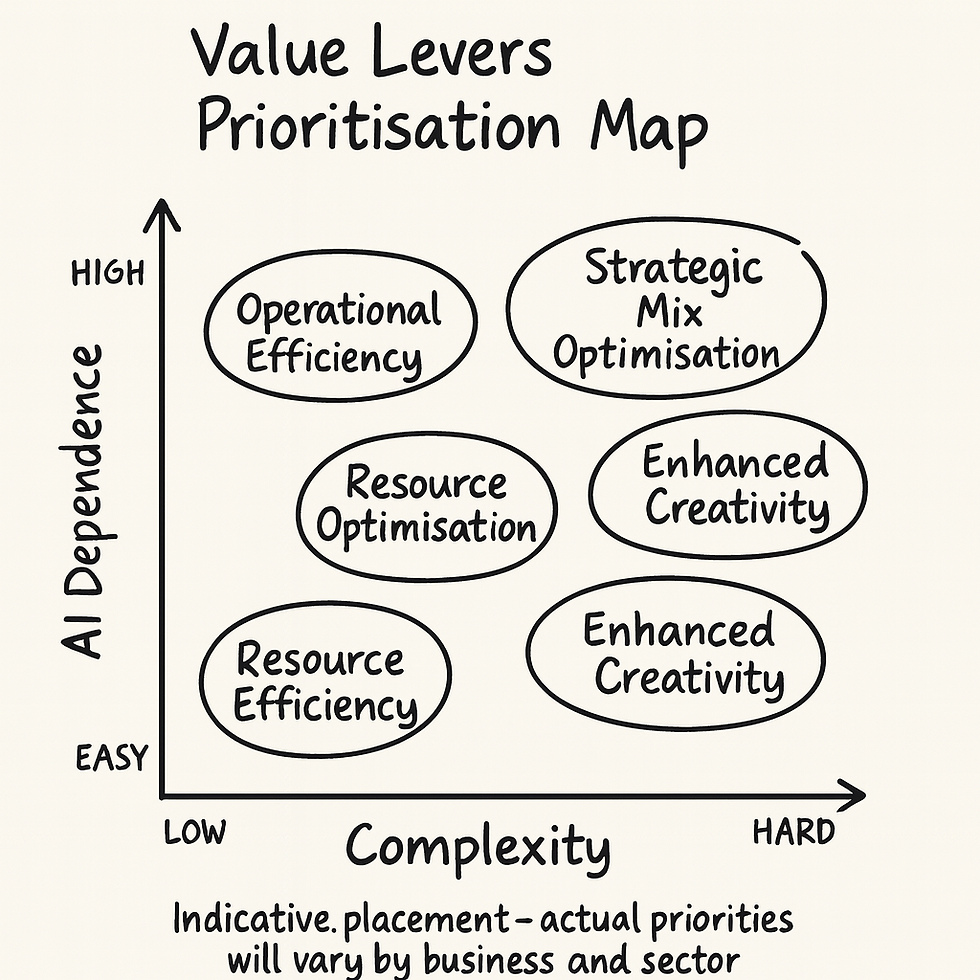
A simple 2×2 matrix, like the one below, can be a helpful way to guide this discussion. It plots each lever based on its complexity and how dependent it is on AI. This example is indicative—you’ll want to assess these dimensions in your own context.
🧭 Where to Start
The framework is intentionally comprehensive—but leaders don’t need to use every lever. As Les Binet and Peter Field remind us, brand building remains the primary growth driver, even in a performance-focused world.
Your task as a leader is to focus:
Map elements of your marketing portfolio to the levers.
Evaluate each lever based on potential value, ease of implementation, and AI relevance.
Choose 2–3 levers that offer the most value today.
Build momentum—then layer capability, governance, and infrastructure adjustments as you scale.
This is about right-sizing your ambition—starting where value is clear and scaling thoughtfully into transformation.
💬 Let’s Continue the Conversation
Which levers feel most relevant for your business? Where are you seeing opportunity—or tension?
💭 Comment below or DM me—always happy to explore how this could apply in your context.
🎯 Takeaway
Here are the three ideas to keep:
Spend better – cut waste and free up resources to reinvest in impact.
Market better – focus on real wins where customer response and ROI flow.
Transform gradually – build for tomorrow without delaying imperatives today.



Comments